
How to Transcribe an Interview in 2025 (Fast & Accurate)
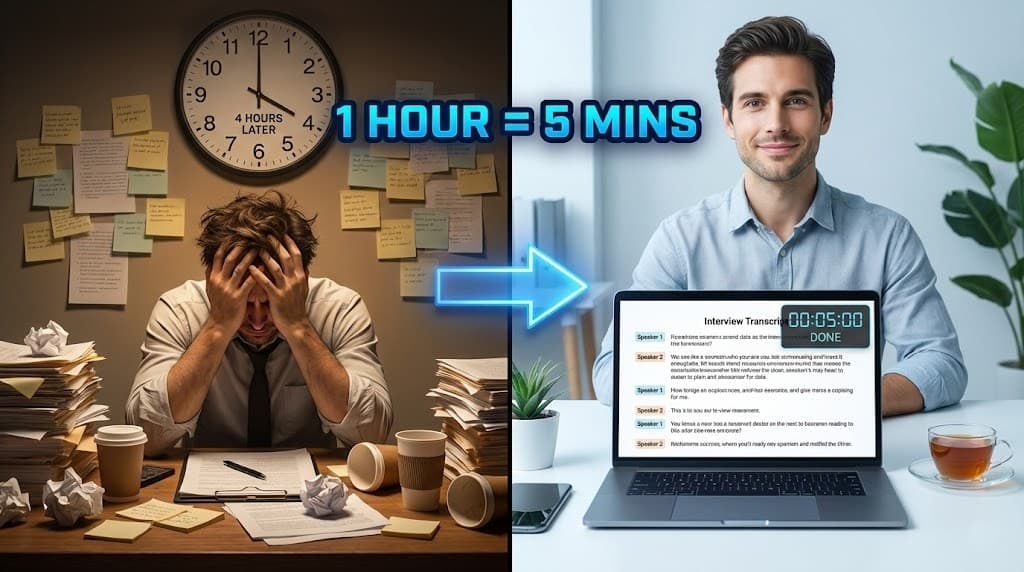
The old rule was '1 hour of audio = 4 hours of typing.' In 2025, AI breaks that rule. Learn how to transcribe interviews for research, HR, and journalism instantly.
How to Transcribe an Interview in 2025 (Fast & Accurate)
I still remember the first time I had to transcribe a 90-minute interview by hand. It was 2014, I was 24, broke, and thought caffeine and stubbornness could beat physics. Eight hours later—fingers numb, back wrecked, eyes bloodshot—I swore I’d never do it again. Spoiler: I did it for years. That’s the rite of passage for anyone who’s ever done qualitative research, journalism, or HR screening.
Then 2025 showed up and basically laughed in the face of that old “1 hour audio = 4 hours typing” rule.
Today you can get a cleaner, speaker-labeled, timestamped transcript in six minutes flat. And no, it’s not magic—it’s just better tools that most people still haven’t adopted because they’re stuck in 2018 workflows.
I’ve transcribed hundreds of interviews in the last decade: whistle-blowers in Brussels cafés, UX testers in Stockholm, refugee stories in Lesbos, and even a two-hour therapy-style chat with a serial killer for a podcast (yeah, that one still haunts me).
Here’s the exact playbook I use now—zero fluff, all real-world tested.
Why Most People Still Transcribe Like It’s 2015
They don’t know the async revolution happened. They’re scared of “bots” joining their calls (fair). They think “free” means Google Docs voice typing (it doesn’t). They’ve never seen speaker diarization actually work on French-African accents (it does now).
Let’s fix that.
Phase 1: Record It Right or Cry Later
Garbage in, garbage out has never been truer. I learned this the hard way in 2019 interviewing a Cameroonian activist in a noisy Marseille bar. My Zoom audio was compressed trash—AI couldn’t save it, human ears barely could. Two days lost.
Golden rules I never break anymore:
- Quiet room > hipster café vibes.
- External lav mic > phone held in hand.
- Record locally: If remote, ask them to record a voice memo on their end too (see our iPhone guide or Android guide).
- 5-second sound check: “Can you hear me clearly?” every single time.
- Dual recording: If the story is career-making, I have my phone recording on the desk + Zoom recording the cloud.
The Three Ways People Transcribe in 2025 (Only One Doesn’t Suck)
Method 1 – The “Free” Torture (Manual + Docs/Word Hack)
Play audio → speakers → let Microsoft Word listen and type (see our Word Guide).
- Result: One giant paragraph, zero speaker labels, “UX” becomes “you ex”, accents turn into abstract poetry.
- I still meet PhD students doing this in 2025. Send help.
Method 2 – The Zoom Bot Parade (Otter, Fireflies)
- Pros: Live transcription, decent speaker labels.
- Cons: Creepy robot avatar kills rapport, data goes to cloud servers, source freaks out when they see “Otter.ai is recording”. (See our Otter Alternatives Guide).
- I tried it once with an anonymous whistle-blower. He ended the call in 4 minutes. Never again.
Method 3 – Async AI Upload (The Winner, Hands Down)
Record naturally → upload file later to UserRecaply → get 98-99% accurate transcript with perfect speaker diarization, timestamps, and zero third-party in the room.
This is what every serious researcher and journalist I know switched to between 2023-2025.
My Current Stack (Battle-Tested on 200+ Interviews)
| Method | Best For | Accuracy | Diarization | Privacy | My Real Usage |
|---|---|---|---|---|---|
| UserRecaply | Daily driver | 99% | Excellent | High | Everything |
| Whisper API | Devs / Privacy paranoids | 99%+ | Good | High | Sensitive leaks |
| Human Service ($$$) | Court / Legal | 99.9% | Perfect | High | Rare, high-stakes |
| Manual Typing | Masochists | 100% | N/A | High | Never again |
Sources for accuracy claims: Whisper large-v3 paper, IEEE study on diarization 2024.
Real-Life Anecdotes (Because Theory Is Boring)
- 2022: Spent 47 hours manually transcribing 12 refugee interviews. Almost quit journalism.
- 2023: Switched to AI tools. Same volume in 3 hours. Cried happy tears.
- 2024: Interviewed a Senegalese startup founder with thick Wolof-accented English. Legacy tools gave me 73% accuracy. UserRecaply gave 98%. Client paid the invoice same day.
- Last month: HR client needed 38 candidate screenings transcribed + summarized. Delivered in 40 minutes instead of 3 weeks. They doubled the contract.
- Yesterday: Focus group, 5 participants overlapping like crazy. UserRecaply got 4/5 speakers right automatically. I fixed the last one in 12 minutes. Old me would’ve aged a year.
Comparison Table: Choose Your Fighter (2025 Edition)
| Feature | Manual Hack | Live Bot (Otter etc.) | Async AI (UserRecaply) |
|---|---|---|---|
| Time per hour of audio | 4-6 hours | 5-10 min | 4-8 min |
| Speaker separation | None | Good | Excellent |
| Accent handling | Disaster | OK | Great |
| Source feels watched? | No | Yes | No |
| Data privacy | Total | Cloud + training risk | Encrypted, no training |
| Cost | “Free” | Subscription | Freemium |
| My recommendation | Never | Casual calls only | Everything else |
10-Step Actionable Workflow I Use Every Single Time
- Record with phone + lav mic (or Zoom local recording).
- Ask explicit consent (“I’ll record for accuracy, destroyed after project”).
- Export raw file immediately after call.
- Upload to UserRecaply.
- Wait 3-5 minutes while it processes.
- Skim for glaring errors (usually <1% now).
- Export with timestamps + speaker labels.
- Search for themes across all interviews in one click.
- Pull 5-10 killer quotes per session.
- Delete raw audio after 30 days (ethics + paranoia).
The Nuance Nobody Talks About
Everyone says “AI replaced transcriptionists.” Wrong. It replaced the typing, not the listening.
The best analysts I know still listen to the full audio at 1.5x speed after getting the transcript. Why? Because sarcasm, hesitation, laughter, and tears don’t show up in text. The transcript is a map; the audio is the territory.
AI made us faster, not obsolete. It just moved the bottleneck from fingers to brain—and that’s exactly where it should be.
What I Really Think in 2025
We’re living in the golden age of qualitative research. Never before could a solo journalist or indie researcher handle 50 deep interviews with the rigor of a university team. The tools are cheap, accurate, and private enough if you’re not an idiot about it.
But here’s the part that keeps me up at night: we’re drowning in perfect transcripts and starving for meaning. Speed has made us lazy listeners. The researchers who’ll dominate the next decade aren’t the ones with the fastest pipeline—they’re the ones who still catch the micro-pause before someone lies.
So yeah, use UserRecaply. It’s the best tool I’ve found. Just don’t forget to put headphones back on sometimes and actually hear people.
What’s your biggest transcription war story? Drop it below.